Playwright AI QualityLab
Operational Quality Engineering powered by Playwright + TypeScript, with release confidence, execution evidence, observability, and AI-assisted triage in one place.
5 suites
Validation paths
Smoke, UI, API, accessibility, and SEO checks are organized as repeatable release workflows instead of one-off scripts.
100/100
Release confidence
The platform summarizes execution outcomes into a clearer release-readiness signal with evidence, coverage status, and critical-failure context.
AI assist
Triage posture
AI helps explain failure patterns and summarize evidence, while Playwright remains the source of execution truth.
Problem
Most automation projects stop at pass or fail, but real teams need operational visibility into release health, execution evidence, coverage, and failure context before they trust a result.
Approach
Built a Playwright and TypeScript quality platform around suite-based execution, dashboard workflows, release-confidence scoring, observability, report history, and AI-assisted triage support.
Impact
The result is a stronger quality-engineering story: a reviewer can explore the hosted app first, then use the case study to understand the system design, workflow, and quality decisions behind it.
AI QE Control Center
A quality control surface that connects Playwright execution, workflow selection, release-confidence scoring, observability, and evidence review.
5 suites
Validation paths
Smoke, UI, API, accessibility, and SEO checks are organized as repeatable release workflows instead of one-off scripts.
100/100
Release confidence
The platform summarizes execution outcomes into a clearer release-readiness signal with evidence, coverage status, and critical-failure context.
AI assist
Triage posture
AI helps explain failure patterns and summarize evidence, while Playwright remains the source of execution truth.
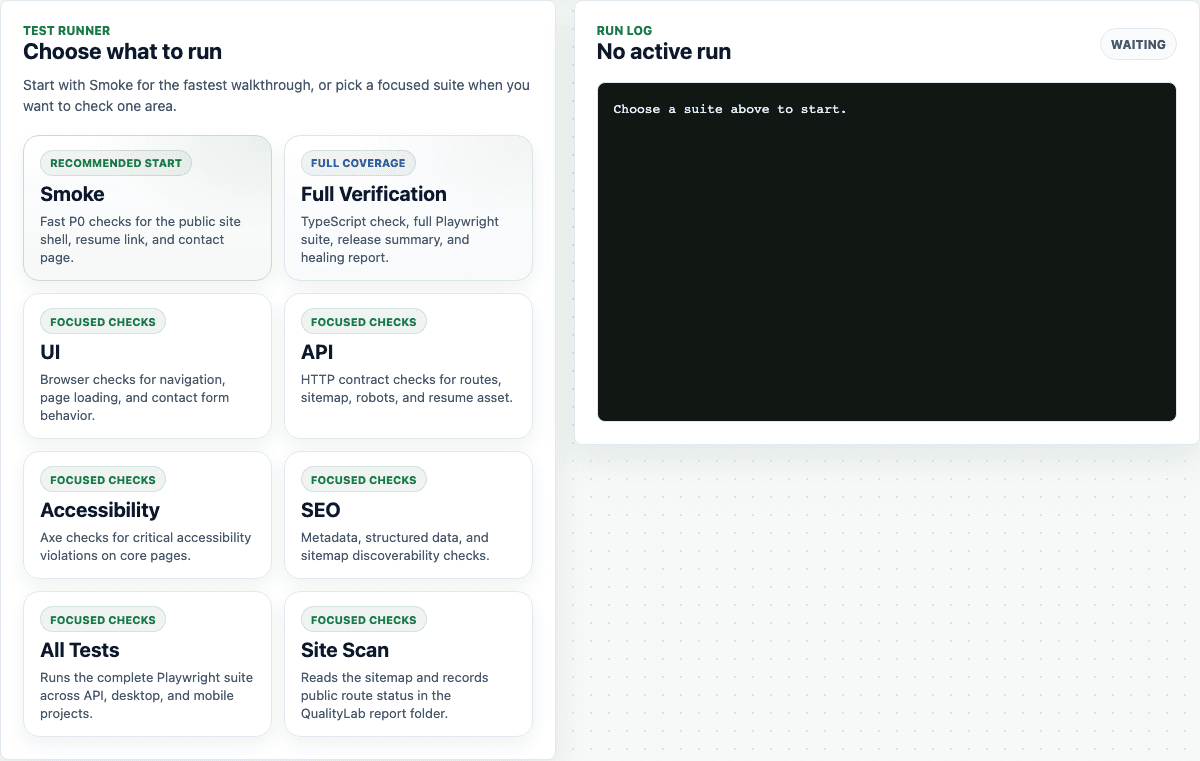
Overview
Playwright AI QualityLab is built to show more than a test folder or a pass-fail report. It treats automation as an operational quality system with workflow-based execution, release-confidence signals, execution evidence, observability, and AI-assisted triage.
The hosted app shows the product surface directly. This case study explains the system behind it and why those signals matter for real release decisions.
Product workflow
The platform is organized around a simple quality loop:
1. choose a validation path such as smoke, UI, API, accessibility, SEO, or full verification 2. run Playwright checks against the configured target 3. generate release-confidence, coverage, and evidence reports 4. review dashboard status, run history, and observability context 5. optionally use AI-assisted summaries to explain failure patterns and triage next steps
That matters because the output is not just a test result. It is a set of operational signals that can support a release decision.
Why the architecture is interesting
The project is more than a test framework. It combines deterministic Playwright execution with operational dashboards, stored evidence, report generation, and AI-assisted triage support.
Workflow-first validation
Instead of treating all tests as one generic run, the platform organizes them into clear validation paths. Smoke, UI, API, accessibility, SEO, and full verification each support a different release need.
Operational visibility
The dashboard is built around release confidence, coverage visibility, report history, and system health. That makes the output more useful than a raw terminal log because the evidence is organized for review.
In practice, that means the system can answer the questions teams actually ask during release validation:
- what ran
- what passed or failed
- whether critical issues exist
- whether the run looks safe to release
- what evidence supports that conclusion
Local-first execution
The hosted demo shows the product surface, but the deeper execution layer still reflects local-first engineering concerns. Runs write artifacts, keep history, generate reports, and expose operational controls, so the project is designed as a real tool first and a portfolio piece second.
Quality and AI decisions
The AI layer is advisory. Playwright remains the source of truth for execution and pass-fail behavior, while AI-assisted reports help explain failures, summarize release confidence, and make the evidence easier to review.
That separation is the important engineering decision. It keeps the automation deterministic while still showing how AI can support a quality workflow without becoming the system of record.
Why it belongs in the portfolio
This project connects software quality, automation architecture, operational thinking, and AI-assisted reporting in one coherent example. It shows how to turn Playwright from a test runner into a more complete release-confidence system with visible workflows, clear evidence, and practical engineering boundaries.
Key signals and links
Stack
Next step