TestPilot AI
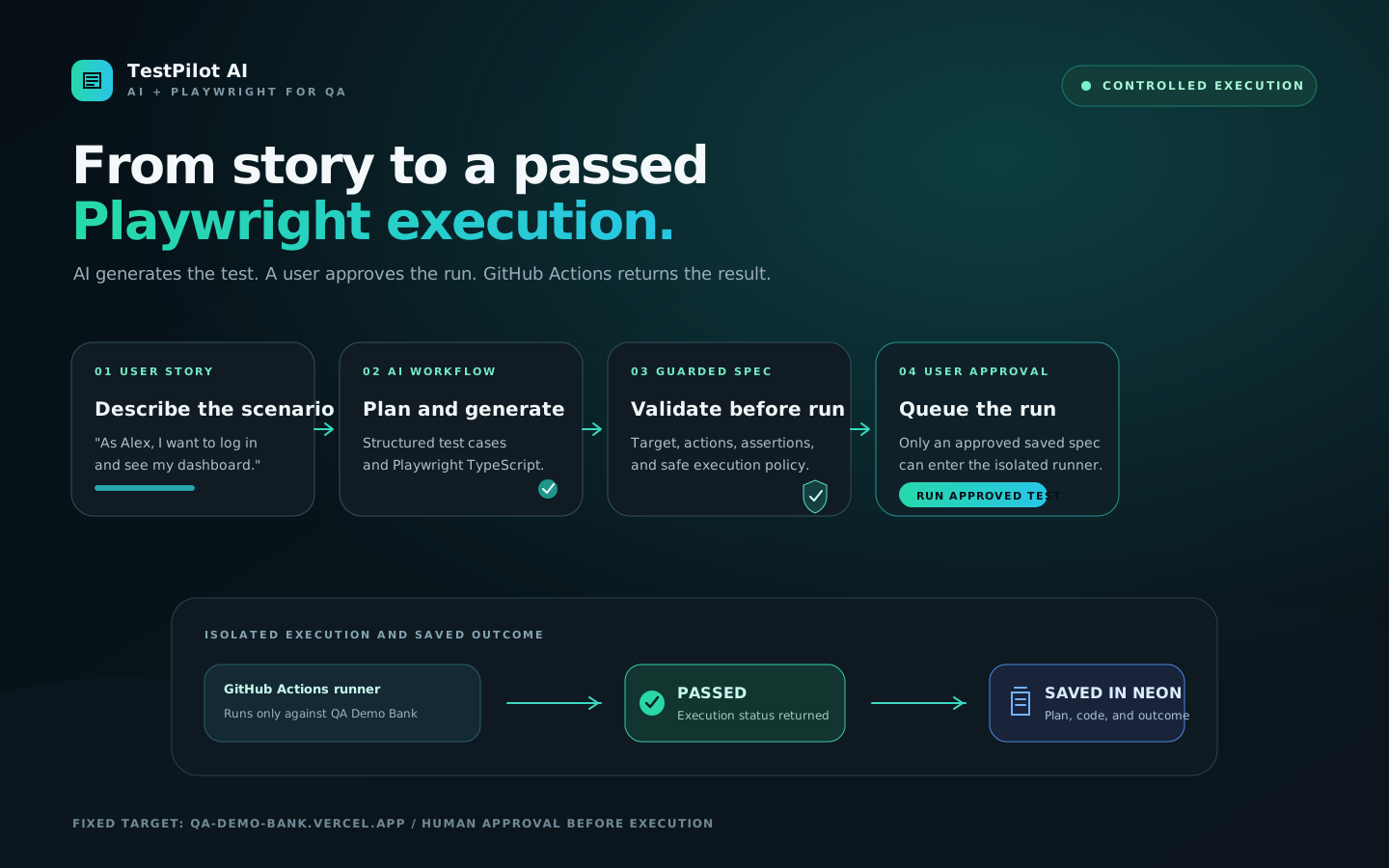
Turn a plain-English user story into a validated Playwright test, then run the approved spec in GitHub Actions.
1 approval
Execution gate
A user explicitly chooses when a validated generated spec is allowed to run.
GitHub Actions
Isolated runner
Approved specs run only against the controlled QA Demo Bank target.
Neon
Saved outcomes
Generated plans, code, and final execution status remain available for review.
Problem
Turning a feature story into useful automation coverage is still slow, inconsistent, and dependent on specialist Playwright knowledge.
Approach
Built a guided workflow that converts a plain-English scenario into a structured test plan, validates a Playwright spec, and hands an approved run to GitHub Actions.
Impact
Gives a reviewer a clear, controlled path from a product story to a saved execution outcome without overstating what AI has done.
From story to approved test execution
A guided workflow that turns a user scenario into guarded Playwright code, then safely runs an approved spec.
1 approval
Execution gate
A user explicitly chooses when a validated generated spec is allowed to run.
GitHub Actions
Isolated runner
Approved specs run only against the controlled QA Demo Bank target.
Neon
Saved outcomes
Generated plans, code, and final execution status remain available for review.
Overview
TestPilot AI explores a practical question for quality engineering: how can a product story become a useful automation workflow without requiring someone to begin from a blank Playwright file?
The POC accepts a plain-English scenario, uses AI to create a structured test plan, generates Playwright TypeScript, validates that output against execution rules, and saves it for review before any browser run begins.
Current workflow
1. describe a user scenario in plain English 2. create a structured QA plan with test cases and risks 3. generate a reviewable Playwright draft for every planned case 4. validate that the draft includes the planned case identifiers, browser actions, assertions, and authentication setup when required 5. save the generated plan and code to Neon Postgres for review 6. let a user queue the approved spec in an isolated GitHub Actions runner, then save the final execution status
The interface is intentionally guided so a first-time automation user can understand what is happening at each step and what they should review next.
Engineering decisions
User-approved execution
TestPilot distinguishes between a generated, validated draft and an executed test. A user explicitly chooses when to run a saved spec; it is never presented as passed before GitHub Actions returns a result.
Guarded code, isolated runner
Generated code is checked before execution and is limited to the QA Demo Bank target. The runner downloads only an approved saved spec, executes it in GitHub Actions, and reports the result back to the TestPilot history.
Public-demo safeguards
The demo is limited to QA Demo Bank scenarios, validates the expected target, caps story length, and limits each IP address to ten plan-generation requests per day. These boundaries protect shared AI capacity and keep the POC focused on a controlled test target.
Reviewable AI output
AI output is treated as a draft to inspect, not as a source of truth. The workflow checks planned-case coverage, browser actions, assertions, authentication setup, and execution policy before it can be queued.
What this project demonstrates
- product thinking applied to a QA workflow
- practical Gemini integration with typed provider errors
- Playwright code generation with execution guardrails
- secure website-triggered GitHub Actions execution
- persistent generated and execution history with Neon Postgres
- clear user experience for people who do not already know test automation
Next phase
The next planned capability is richer failure triage and execution evidence. Test generation, approval, isolated execution, and saved results are already part of the current demo.
Key signals and links
Stack
Next step